The work behind the multiplication of trainers
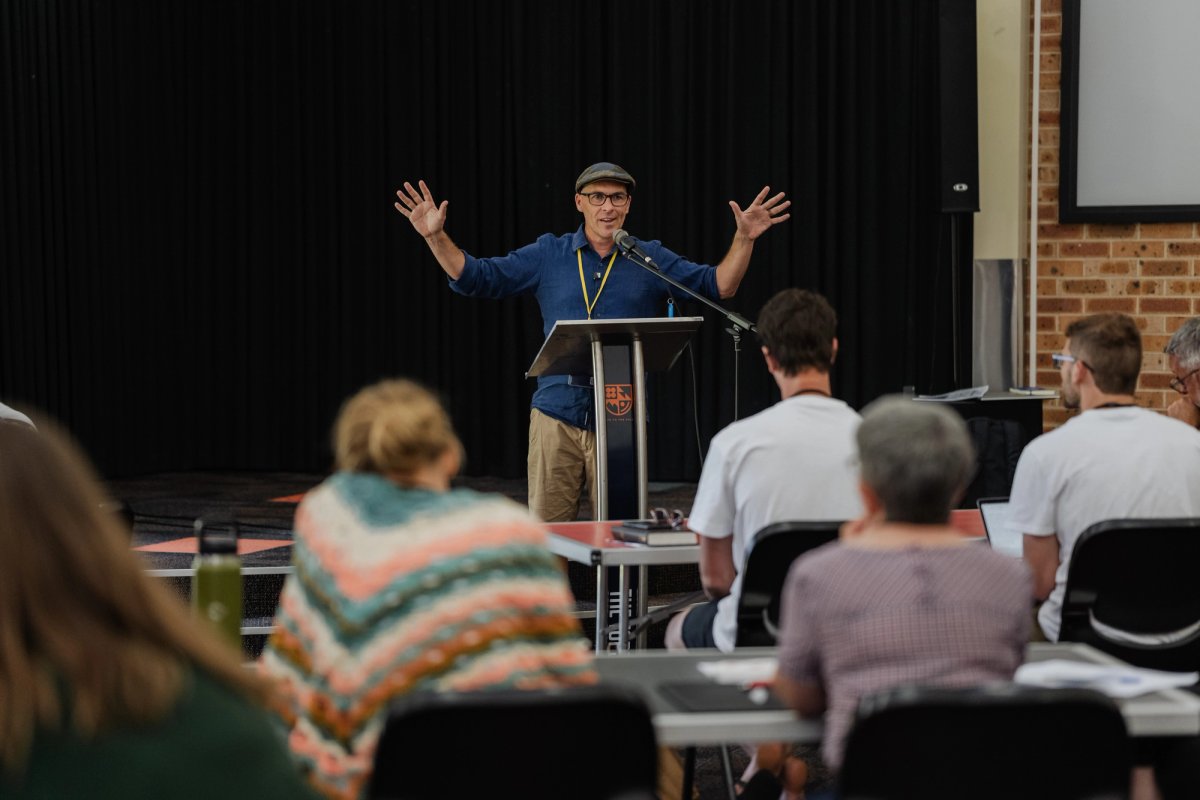
There is a question that Russ Smidt wants every gospel worker to think about every time they spot the MTS logo or cross paths with someone from the team.
“Who am I entrusting this to?”
It’s the question at the heart of 2 Timothy 2:2, and certainly at the heart of all MTS seeks to help churches and organisations do.
Russ is Head of Training & Partnerships at MTS, and Clare Merkel is Trainer Coordinator, both are part of the Training & Partnerships team at MTS.
The importance of training and partnerships
At its simplest, MTS’s Training & Partnerships team is responsible for raising up and equipping healthy gospel ministry trainers.
Clare’s role provides hands-on support to trainers as they raise up and walk alongside their apprentices — helping them think through curriculum, navigate relational complexity, and develop clear training goals. She works with trainers at the point of onboarding and stays available to them well beyond it.
“I spend a lot of time with people who either are about to bring apprentices on or have already brought apprentices on,” Clare explains. “I help them think through what it looks like to be a healthy and helpful trainer. That includes developing curriculum objectives, but it can also mean the pastoral and relational side, coaching across different facets.”
Russ, meanwhile, works at a broader strategic level, cultivating partnerships with churches, denominations, and ministry organisations; envisioning trainers with the multi-generational vision of 2 Timothy 2:2; and working to embed a culture of multiplication wherever MTS has a presence.
The mission that drives it all
MTS is not just trying to produce more apprentices.
“MTS is training people to be gospel workers who raise and train other gospel workers to be gospel workers who raise and train other people,” Russ says. “Our distinctive is the multi-generational impact.”
He takes that vision seriously enough to say, “If MTS achieves its goal, and it should aim to achieve its goal this side of eternity, its goal is to cease to exist. Because then 2 Timothy 2:2 would be embedded into every gospel worker.”
For Russ, that’s simply the logical end point of the work — raising up trainers so envisioned and so equipped that multiplication carries on.
But we’re not there yet. The harvest is still plentiful, and the workers are still few. So, we keep going.
Encouragement from the movement
For Clare, she loves to see growth in trainers in a way that is not measured primarily in statistics. It’s visible in something harder to quantify.
“You can really tell when someone’s driven by that conviction as opposed to fulfilling requirements,” she says. “A healthy gospel ministry trainer is one where their biblical convictions shape the way they do all of ministry, and that includes training people and equipping the saints for works of service.”
She points to Anna as one example. A woman who gathered a group of ten women from her local church to study 2 Timothy together, build confidence in ministry, and share how they were serving. None of it would appear in MTS’s figures as an apprenticeship. But for Clare, it signals exactly the kind of healthy trainer culture the team hopes to cultivate.
Russ tells the story of Luke, a pastor at a small country church that has historically not had the funds to afford a full-time minister. Three years ago, when asked how he could possibly think about raising up apprentices, Luke said he had simply started reading the Bible one-on-one with two Year 4 kids. “As far as I can see, they are my most likely next apprentices. So, I’m going to keep reading the Bible with them for the next ten years.”
Three years on, that same church has taken on an apprentice — not the Year 4 kids yet — but as a result of God working in his people and funded by a congregation who previously couldn’t pay their own pastor.
Why this work matters
When asked what would disappear if the Training & Partnerships team ceased to exist, both Russ and Clare arrive at a similar answer. The infrastructure that makes the biblical mandate feel possible, and the ongoing presence that keeps it on the agenda.

“Nobody else will hold a pastor accountable for this,” Russ says. “A congregation member will not knock on your door. Denominations are unlikely to do it. We at MTS keep banging the drum, not hanging it over their heads, but making sure that every time somebody crosses paths with MTS, they’re prompted to consider, ‘Who am I entrusting this to?’”
Clare describes MTS, and the Training & Partnerships team specifically, as scaffolding. A temporary, movable support structure that makes it possible for something else to be built.
“We’re the support network. We offer frameworks and structures that support trainers, but they’re the builders. If we didn’t exist, I don’t think it would happen, because gospel workers wouldn’t have that support or framework there.”
She describes experienced ministry leaders, including men decades her senior, who have asked her to call them in four weeks to check they’re doing what they’ve learned. “They are so convicted to be healthy trainers that they want to be held to account,” she says.
What your investment makes possible
When someone gives to MTS, Russ says they are funding something both simple and vast.
“They’re funding the possibility and the promise that churches, now and into the future, will be healthier, because they have healthier leaders among them: pastors, elders, support people, congregation members who are shaped by a commitment to 2 Timothy 2:2.”
Clare puts it in practical terms, “Their dollar is making possible the work of MTS putting on support staff and developing resources that enable trainers to actually do the work of raising up and training apprentices.”
More investment, she says, means more reach, but also a deeper reach, with more individual gospel workers personally and intentionally supported.
And that depth, as Russ sees it, is where the multiplication takes hold. Not just in statistics, but in trainers who are so envisioned and so equipped that they set something in motion that, in time, does not stop.
“When we do that really, really well,” he says, “MTS can cease to exist. But we’re not there yet.” God’s not done calling people to himself, and so the harvest still needs workers.